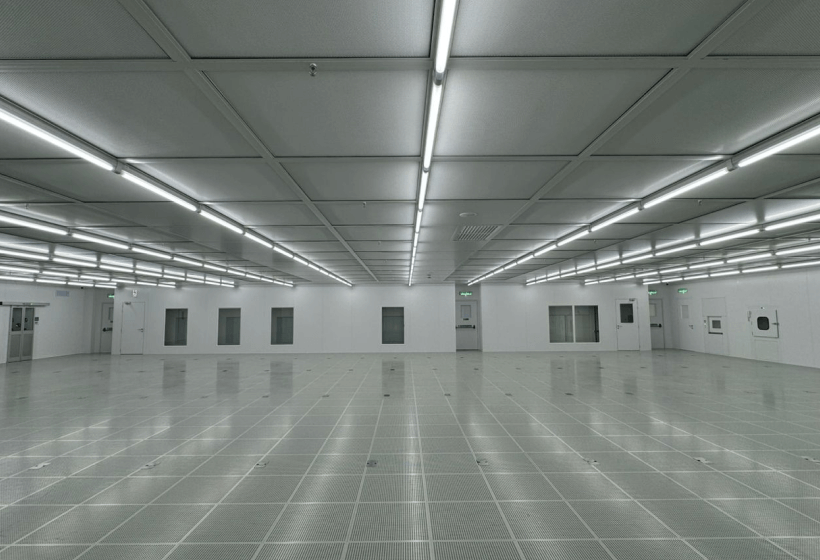
Cleanroom facilities are becoming one of the most technically demanding aspects of modern industrial design. In sectors such as semiconductor manufacturing and biotechnology, environmental control is no longer an added feature. It is a core requirement. Across Malaysia, demand for cleanroom systems is increasing as manufacturers invest in higher production standards, tighter process tolerances, and full compliance with international guidelines.
This rise is not driven by trend alone. It is the result of growing technical complexity, globalised production networks, and the increasing need for product consistency across regulated markets. Engineering teams today must address cleanroom performance from the earliest stages of design, with full integration of mechanical systems, airflow control, and monitoring capabilities.
1. Smaller nodes in semiconductor fabrication require stricter environmental control
In semiconductor manufacturing, even microscopic particles or unstable humidity can affect process accuracy. As chip designs move toward smaller nodes and higher transistor density, contamination risks multiply. Production yields depend on maintaining stable, classified environments where every variable is controlled and traceable.
Cleanroom requirements in this sector typically fall within ISO Class 5 to Class 7. These environments are maintained using layered air filtration, directional airflow, temperature and humidity regulation, and positive pressure zoning. Air handling systems must respond continuously to thermal load changes, while maintaining cleanliness levels within tight tolerances.
The cleanroom is no longer confined to front-end fabrication alone. Assembly, testing, and back-end processes are increasingly carried out in classified spaces to preserve product quality across the production chain.
2. Regulatory requirements in biotech and pharma mandate cleanroom adoption
In biotechnology and pharmaceutical production, cleanrooms serve not only as process enablers but as regulatory obligations. Facilities are built to comply with Good Manufacturing Practice, ISO 14644, and national health authority requirements. Environmental controls support the safe manufacture of sterile drugs, vaccines, diagnostics, and biologics.
Zoning strategies are used to separate personnel flow, material transfer, and process steps. Differential pressure is applied to prevent cross-contamination, and filtration standards must be maintained during both static and operational conditions. In Malaysia, growth in life sciences investment has led to more demand for cleanroom-equipped laboratories and production suites, particularly in areas focused on export-grade compliance.
As product types expand to include cell therapy, high-potency compounds, and personalised medicine, cleanroom flexibility and modularity have become more important.
3. Malaysia’s expanding high-tech industry is integrating cleanrooms into new projects
Malaysia’s role in high-value manufacturing is expanding. Facilities in Penang, Selangor, and Johor are being developed not only by semiconductor and life sciences firms but also by producers of optics, aerospace components, batteries, and precision medical equipment. Cleanroom infrastructure is central to these industries, which require stable environmental conditions to meet international standards.
As manufacturers deepen their local footprint, many are integrating cleanrooms into early-stage facility planning. These spaces are engineered for long-term compliance, continuous operation, and integration with Building Management Systems. Their role is no longer secondary. The cleanroom is now considered an essential function of the modern production floor.
4. Manufacturers are retrofitting older facilities to meet updated compliance standards
Cleanroom projects are not always part of greenfield construction. Many existing facilities are being retrofitted to meet new product requirements or to align with updated compliance standards. These projects often involve upgrades to filtration, environmental control panels, pressure zoning, and data integration.
Unlike new builds, retrofits must work around existing conditions. Ducts and equipment must be adapted, not replaced. Air balancing must be recalibrated without disrupting adjacent operations. The cleanroom may need to remain partially operational, requiring a phased approach to installation and testing.
Such projects reflect an important trend: as regulations evolve and product complexity increases, existing facilities must upgrade their environmental controls to remain competitive and compliant.
Engineering complexity requires full-system alignment
Cleanroom system design extends beyond HVAC selection. It requires coordination between architectural layout, process flow, duct routing, filter placement, and environmental monitoring. Each subsystem must support the overall classification strategy without introducing contamination risk or operational inefficiency.
Pressure gradients must be maintained between rooms and corridors. Return air must be filtered and redirected without short-circuiting airflow patterns. Structural materials must be selected to minimise particulate generation and allow for cleaning. Equipment heat loads must be anticipated so that temperature stability is preserved throughout shifts.
Sustainability and energy use are now primary concerns
Cleanrooms are energy-intensive. Maintaining particulate control, temperature stability, and high air change rates requires significant airflow and constant conditioning. For this reason, sustainability has become a key consideration in cleanroom design.
System designers now aim to reduce unnecessary overconditioning by applying demand-based airflow control, fan optimisation, and heat recovery. Cleanroom zoning is used to isolate high-grade areas from less sensitive zones, allowing for differential conditioning and reduced load on central systems. Facility owners increasingly expect energy reporting tools and integration with broader sustainability frameworks.
Conclusion
The rise in cleanroom demand is closely linked to measurable changes in how semiconductors and pharmaceuticals are manufactured. Increasing sensitivity in chip production, stricter regulatory compliance in biotech, and the expansion of advanced industries in Malaysia are all driving more widespread cleanroom adoption.
At the same time, facilities are also revisiting existing spaces, triggering upgrades and retrofits that further expand the cleanroom footprint. While technical complexity and sustainability remain ongoing considerations, the primary drivers are clear: cleanrooms are now fundamental to performance, compliance, and product quality in high-value sectors.